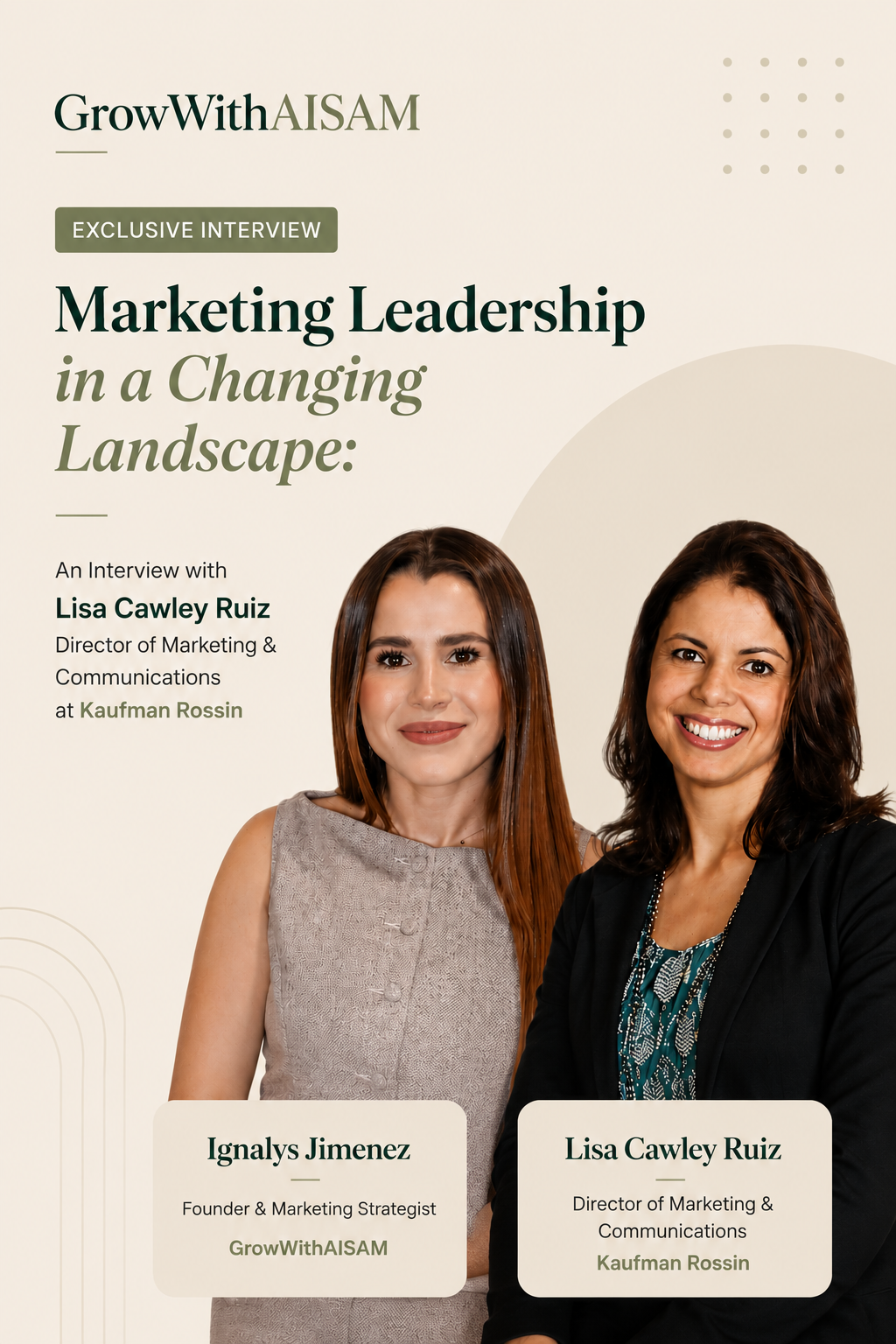
Marketing Leadership in a
changing landscape…
An Interview with Lisa Cawley Ruiz - Director of Marketing & Communications at Kaufman Rossin
At GrowWithAISAM, I truly value opportunities to learn from marketing leaders whose experience bridges strategy, storytelling, and measurable business impact. It was a pleasure collaborating again with Lisa Cawley Ruiz, Director of Marketing & Communications at Kaufman Rossin, and reconnecting through a conversation centered on the ever-evolving marketing landscape.
With 20 years of experience spanning marketing, communications, and journalism, Lisa brings a thoughtful and results-driven perspective to the industry. Her expertise includes aligning marketing strategies with business goals, content planning, and leading impactful communications that attract, convert, and retain audiences throughout the customer journey.
In this interview, we explored marketing leadership in a changing landscape, the importance of adaptability, continuous learning, and how marketers can balance creativity, technology, and human connection to create meaningful results. Whether you are a marketer, entrepreneur, or someone growing in the field, Lisa’s insights offer practical and inspiring takeaways for navigating an industry that continues to evolve.
Every marketing leader has a story, and Lisa’s journey is one rooted in adaptability, curiosity, and continuous growth. Before diving into industry trends, leadership, and the future of marketing, I wanted to better understand the experiences that shaped her career and perspective. We dived into our conversation by discussing how she first got into marketing and the path that led her to where she is today.
Question 1: How did you first get into marketing, and what shaped your career path?
“A pivot actually landed me here. My undergraduate degree is in journalism, and that’s where I started my career. However, when the media industry began to struggle just a few years after I graduated, I had to make a change. I looked for another field where I could transfer my skills, and marketing was a natural fit. In fact, one of my early marketing roles was as a brand journalist.
One thing I love about this discipline is that there's always something new to learn, a new challenge to tackle, a new way to grow. I’m a big believer in lifelong learning, and I’ve been fortunate to have had great growth opportunities and mentors along the way. Last year, I went back to school to earn my master’s degree in marketing, building on my nearly two decades of real-world experience. It’s an exciting time to be in this field, and I can't wait to see what comes next.”
One major takeaway from Lisa’s response was the importance of adaptability and lifelong learning. Her career path demonstrated that transferable skills and a willingness to pivot can create new opportunities for growth.
Question 2: What separates great marketers from average marketers today?
“Staying on top of the latest social media trends will help keep your brand in the conversation. What it won’t do though, is make your brand stand out. The best marketers don’t just follow the crowd, they think differently. What can you do that your competitors are not doing? Where else is your audience spending time, and how can you show up there in a memorable way? Don’t just jump on the trends. Find the white space and go there.”
Lisa emphasized the importance of strategic differentiation. Rather than simply following digital trends, marketers should focus on identifying opportunities that competitors are overlooking and building memorable brand experiences.
Question 3: What skills do you believe new marketers absolutely need to develop over the next five years?
“Five years feels like a long horizon right now. With how quickly technology is advancing and the landscape is shifting, it’s hard to see that far into the future. I would tell marketers entering the field today to focus on the next 12–18 months. In the immediate future, the most important hard skill to hone is AI fluency, from prompt engineering and platform proficiency to agentic workflow operations. Marketers need to know how to leverage these powerful tools for sustainable, scalable growth.
The flip side is that soft skills, the ones that make us uniquely human, are becoming more valuable than ever in an increasingly digital world. Critical thinking, creativity, and relationship building are key areas to develop, no matter where your career path takes you.”
One of the strongest themes in this interview was balance. Lisa highlighted that while AI fluency is becoming increasingly important, marketers cannot neglect human-centered skills such as creativity, communication, and relationship building.
Question 4: How do you approach building a brand that creates emotional connection with consumers?
“Before you can connect with your customers, you first need to understand them. Know your audience, what they need, what they aspire to, what keeps them up at night, what makes them tick. When you do the work to understand your customers, you will be better positioned to build a brand that resonates with them on an emotional level. Tailor your messaging in a way that speaks to them and helps them see themselves in what you say and what you do.”
Lisa’s perspective reinforced an important marketing principle: emotional branding begins with customer understanding. Brands build stronger connections when they genuinely understand consumer motivations, challenges, and aspirations.
Question 5: What’s one marketing mistake you see businesses repeatedly making?
“Many businesses make their marketing messaging all about them. Marketing should always answer, ‘What’s in it for me?’ from the customer’s perspective. Your customers need to see relevance and value and a reason for them to care. How will your product or service improve their lives and help them achieve their goals? How will it solve a problem for them?”
This response highlighted the importance of customer-centered messaging. Businesses that focus only on themselves often miss opportunities to create relevance and emotional connection with their audience.
Question 6: Looking back, what’s one lesson you wish you learned earlier in your career?
“I’ve known a lot of marketers who entered this field thinking they could just focus on creative and avoid the numbers. But at the end of the day, marketing is about driving business, and numbers are the bottom line. You need to take the time to understand the business you are working for. What are the business goals? What drives sales? Which products and services are the most profitable? Where are the gaps? If you understand the business, you’ll be able to have a greater impact.”
Lisa’s response emphasized a powerful lesson for aspiring marketers: creativity alone is not enough. Strong marketers understand business performance, analytics, and measurable impact in addition to storytelling and branding.
A major takeaway from this interview was that successful marketers must continuously adapt while balancing technological fluency with human-centered thinking. Lisa emphasized that understanding customers, thinking strategically, embracing AI, and grounding creativity in business outcomes are all critical to success in modern marketing.
Her experiences demonstrated that marketing is both creative and analytical, requiring curiosity, flexibility, and a willingness to evolve. Perhaps most importantly, this interview reinforced the value of lifelong learning and remaining adaptable in an industry that constantly changes.
Before closing, I want to extend a sincere thank you to Lisa Cawley Ruiz for sharing her time, expertise, and perspective with the GrowWithAISAM community. It was a pleasure learning from your journey and discussing the evolving landscape of marketing leadership.